Despite it being a very busy period, lately I have been spending a bit of background time thinking about how to improve cujpegxl, the GPU-accelerated JPEG XL encoder I described in a previous post. My next planned step involves three phases: a runtime optimization of the current version, followed by a feature extension to improve bit-per-pixel (bpp) at fixed quality (or vice versa), then again followed by a further runtime optimization of the extended code.
A useful lever for this project is the existence of a mature and robust open-source reference implementation of the JPEG XL algorithm in libjxl. In order to decide which features to prioritize, I conducted a small ablation study on the libjxl encoder to see the impact of various parts of the algorithm on the resulting bpp, whose results are described in this post.
Note that cujpegxl is an AI-heavy project, and most of the code and tooling around it is AI-generated. It is not vibe-coding however, but rather a seriously engineered project.
Background
cujpegxl is a JPEG XL encoder that runs entirely on the GPU and its main ambition is speed, aimed at real-time applications on (relatively) constrained devices. In its first1 iteration, it compresses 4K frames in about 50 ms on a GTX 1080 Ti, which is still far from the desired performance.
Given the complexity of the JPEG XL algorithm, speed here comes at a price. At equal visual quality, the cujpegxl output can be up to 40–50% larger than libjxl’s, since the latter runs a complete (and slower) version of the algorithm. In the current version of cujpegxl, notable exclusions include:
- Entropy coding is prefix-only. rANS coding is not implemented.
- LZ77 pre-pass is omitted.
- No non-square, <8 and >32 transforms.
- No iterative Butteraugli rate control.
- No optimized coefficient orders.
Some numerical approximations and simplifications are also made for performance reasons, trading a bit of quality for speed:
- Huffman codes limited to 15 bit.
- Transform selection uses a simpler heuristic.
- Fuzzy erosion is local (clamped to a 32px tile) as opposed to global.
- Fixed-size 32-cluster map, with one histogram per group, as opposed to the full greedy cost-driven clustering of 7425 contexts performed by libjxl.
- DCT coefficients stored as FP16.
- Uniform field quant calibration.
- Fixed-strength inverse Gaborish pre-sharpening.
- Simplified CfL estimation.
Study setup
Since cujpegxl already implements a subset of libjxl, the study targets a limited subset of algorithm parts, using as baseline libjxl at effort 7. Each experiment disables a specific feature, and measures the difference in bpp with respect to the baseline.
Since not all features are directly controllable through the libjxl API, this experiment uses a small patch adding some toggles to disable the algorithm’s parts of interest.
The study sweeps over nine quality values, from Butteraugli distance 0.5 to 4.0 and experiments with 20 variants, for a total of 720 image encodings.
Dataset
The dataset used here is the four 4K image set used for iterative development in cujpegxl. It is admittedly small and does not give strong statistical significance to the results, but it allows for fast iteration, which greatly helps.2
Ablation variants
The ablated parts in the experiments can be roughly grouped into four categories.
- Entropy coding:
- Forcing Huffman coding over rANS.
- Number of context clusters.
- Coefficient ordering.
- LZ77 pre-pass.
- Block context map size.
- Filters and quantization:
- Per-block quantization adjustment.
- Quantization deadzone.
- Gaborish smooting/pre-sharpening.
- Edge-preserving filter (EPF).
- Adaptive EPF strength.
- Adaptive chroma-from-luma (CfL)
- Transforms and their block sizes:
- Limit block size to 8x8, 16x16, or 32x32.
- Include rectangular blocks.
- Include smaller blocks (2x2, 4x4, 4x8).
- Include alternative transforms (identity, AFV).
- Include larger blocks (64x32, 64x64).
- Perceptual rate control
- Butteraugli feedback.
Metrics
The metrics used for evaluation are the usual: Butteraugli (which libjxl is tuned for, and therefore inherently biased), SSIMULACRA2 (a state-of-the-art perceptual metric), and PSNR (non-perceptive, but a widely used metric that gives us some measure of pixel-level error).
For each variant and metric, the bpp-vs-quality curve is drawn, then compared with the baseline curve (from libjxl effort 7). The Bjøntegaard Delta rate (BD-rate) [1] is then computed and reported for each metric. A positive change of +x % means that removing the ablated feature makes the compressed codestream x % larger (and therefore worse compression rate), while a negative change means an improvement in compression rate.
Results
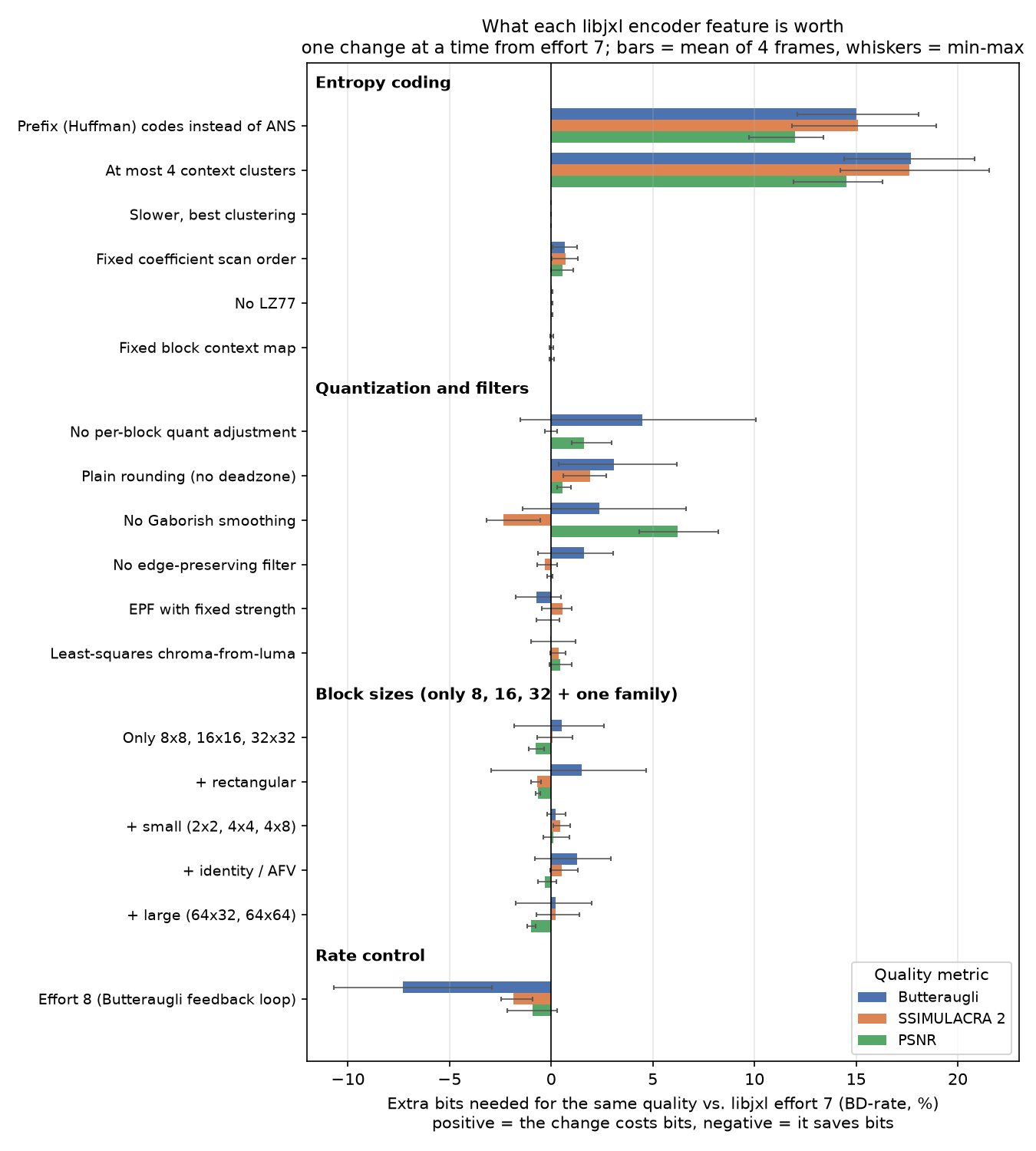
The plot below shows the BD-rate change for each ablated part. Here the whiskers denote minimum and maximum, given the small dataset sample. Note that each variant is tested in isolation, so interaction between parts is not accounted for in this study (as testing the full matrix of combinations would take too much time).
When reading the BD-rate plot, a positive change represents a worsening of the compression rate over the baseline (libjxl effort 7), a negative change represents an improvement. Since we are removing features from the encoder, we expect changes to be on the positive side (regressions), except for the addition of Butteraugli loop control (from libjxl effort 8), which instead adds a feature not present on the baseline and is therefore expected to be an improvement.
Entropy coding
Entropy coding immediately strikes as the dominant source of bpp improvement, where both rANS and increasing the number of context clusters give comparable improvements. This is expected, as Huffman coding allocates at least one bit per symbol, while rANS allows allocating sub-bit amounts per symbol. It is also valuable as it represents a purely lossless source of compression rate improvement. The risk coming with it is the complexity of optimizing it on GPU, and making sure that the implementation comes without completely blowing up the runtime budget.
libjxl tracks thousands of contexts, defining sets of properties characterizing a block, and it groups them into clusters that share a probability table. Allowing for a finer-grained clustering allows for a substantial bpp improvement. However, falling back to a simpler search method over the default one makes no difference on this dataset.
Compared to the two changes above, coefficient order makes a much smaller but consistent improvement, while LZ77 pre-pass and adaptive context map made no meaningful difference.
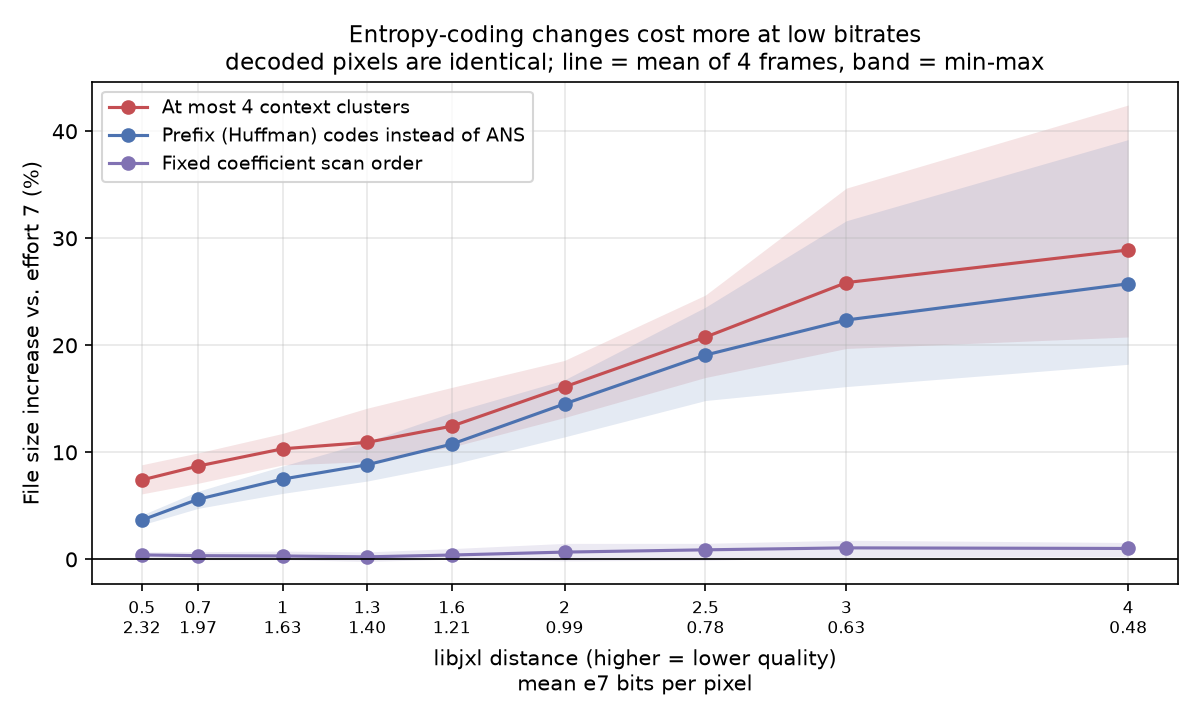
We can also visualize how the effect of these features is more pronounced at lower quality (i.e. higher target compression rate), where it is therefore possible to achieve substantially larger wins:
Quantization and filters
Playing with quantization and filter features shows some interesting results, albeit smaller and less straightforward as we start seeing the different metrics diverge.
A feature of libjxl is the so-called deadzone quantization, which rounds small values to zero a bit more eagerly than ordinary rounding. It is a consistent win of 0.5-3%, and should be a cheap addition to cujpegxl (which currently only uses regular rounding).
Per-block adaptive quantization gives a relatively large improvement to Butteraugli and a smaller one to the PSNR, but it does not seem to improve SSIMULACRA2 on these data.
JPEG XL uses a Gaborish smoothing filter in the decoder, and the encoder compensates for it by pre-sharpening the image (for which cujpegxl uses a fixed pre-sharpening strength). Ablating the Gaborish pre-sharpening indicates that the feature is improving both Butteraugli and PSNR, but actually has the opposite effect on SSIMULACRA2 (at least on this dataset).
JPEG XL also uses a separate edge-preserving filter (EPF) to smooth the compression artifacts. The filter itself is actually applied by the decoder, but the encoder is responsible for deciding how many filter passes to run and for building a per-block sharpness map. Ablation suggests that on this dataset the EPF has a small positive impact on Butteraugli but not a significant one on the other metrics. Moreover, adaptive EPF strength seems to have only a very limited impact.
Block sizes
JPEG XL can choose from about a few dozen transform block sizes and shapes, ranging from 2x2 to 256x256. Restricting libjxl to just 8x8, 16x16 and 32x32 (as cujpegxl currently does) worsens file sizes by less than 1 %. Adding back any single family of shapes among the ones under test improves the result by at most ±1.5 %. That is a rather limited change and within the variation among individual images.
Adding extra shapes is a relatively low hanging fruit, but also a relatively low value one.
Butteraugli feedback loop
The impact of adding Butteraugli loop control (libjxl effort 8) gives an interesting albeit expected result. It gives a big improvement in BD-rate on the Butteraugli distance (the metric it is optimizing, and therefore biased towards), and a measurable but much smaller improvement for other metrics.
It however adds a huge runtime cost, making the libjxl encoder over six times slower compared to effort 7, so it is unlikely to be viable on a high performance implementation, short maybe of a single-shot approach rather than an iterative one like in libjxl.
Conclusions
The results are quite telling, and suggest a way to prioritize additions to cujpegxl. Most of the bpp gain is in entropy coding, where rANS addition and higher context cluster count alone represent most of the attainable overall improvement. The caveat is that rANS has a fair share of complexity and it is non-trivial to make GPU friendly. Increasing the number of context clusters can potentially be a lower hanging fruit if sticking to a static fixed number of clusters, while switching to a dynamic count would require a bit more implementation work and an additional runtime cost. Quantization fixes should then follow, especially considering how most of them are fairly cheap and easy to implement. Increasing the variety of block sizes is also quite easy but likely to give lower gains, especially on unbiased metrics. Finally, Butteraugli rate control is very expensive and can be considered last, if at all.
Note that this study is not meant as a general evaluation of the libjxl encoding front-end. The results are intentionally limited to a small dataset and therefore they do not correctly represent the performance of libjxl features in the general case. Moreover, features that only seem to give minor contributions can still be relevant for a general purpose codec for a format with a very high scope and domain of application such as JPEG XL. In fact this study has a very specific and narrow scope, being solely aimed at identifying and prioritizing candidates for extension and optimization of cujpegxl.
References
- G. Bjøntegaard, “Calculation of Average PSNR Differences between RD-Curves,” ITU-T Video Coding Experts Group (VCEG), Austin, Texas, USA, Technical contribution VCEG-M33, Apr. 2001.